

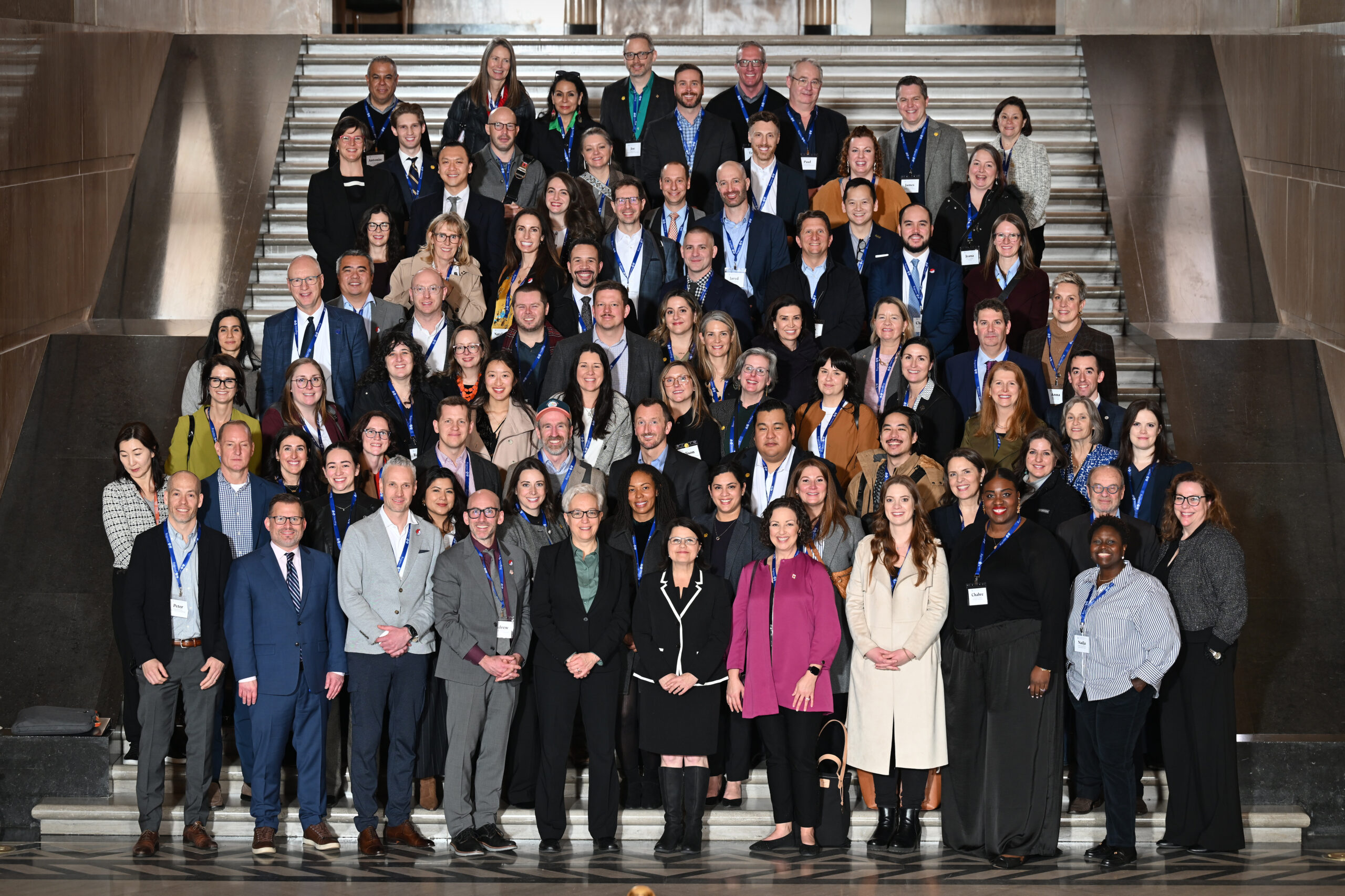
The legislative short session is over! The Chamber was proud to lead over 150 business and community leaders in traveling to the State Capitol during the session on our Portland Advocacy Day, where we advocated for key statewide business priorities. Thank you to the many business community leaders who got involved and contributed their voices. Because of your advocacy, we secured important wins for Portland.
2026 State Legislative Action Plan
A “short session” is a constitutionally mandated, 35-day session held in even-numbered years, different from the 160-day “long session” in odd-numbered years. It began February 2 and adjourned on March 6.
Our team engaged state legislators to support bills that presented opportunities for economic growth (proactive priorities) and oppose bills that would threaten the Oregon business community (defensive priorities):
Proactive Priorities:
- Moda Center Modernization – SB 1501
- Session Outcome: Passed by the State Legislature, awaiting Governor’s signature
- Background: The Moda Center is a critical economic and cultural hub for the state, and taxes generated at the Moda have long supported the state’s general fund. It is also a big piece of the revitalization of the Lower Albina neighborhood. The Chamber supported SB1501 to ensure the Trail Blazer’s future in Portland and support Portland’s reputation as a world-class sports destination.
- Read the Chamber’s Testimony
- Capital Projects – SB 5701
- Session Outcome: Legislature approved funding for the Williams & Russell Business Hub. Awaiting Governor’s signature. Funding may be approved for the Lan Su Garden expansion and the Broadway Corridor project during a future session.
- Background: SB 5701 would support investment in the Williams & Russell Business Hub, Lan Su Garden expansion and the Broadway Corridor project.
- Williams & Russell Business Hub: Create an incubator for entrepreneurs and small businesses in Portland’s Albina neighborhood.
- Lan Su Garden: Transform this classic Portland landmark to expand the organization’s opportunities for education and celebration.
- Broadway Corridor: Create nearly 4 million square feet for new high-density employment, mixed-income housing, and signature attractions and amenities.
- Read the Chamber’s Testimony
- Oregon Jobs Act – SB 1586
- Session Outcome: Not passed by the State Legislature.
- Background: SB 1586 would address the region’s shortage of developable land by adding 373 acres of development-ready industrial land into the Urban Growth Boundary (UGB) for advanced manufacturing and supply chain partners. Another 1,300 acres would be redesignated as urban reserve, allowing it to be considered in a future UGB decision. It would prohibit stand-alone data centers to ensure land is reserved for high-impact job creation. The bill would support tens of thousands of potential manufacturing and traded sector jobs, strengthening Oregon’s long-term economic base.
- CEI Hub Financial Assurance – SB 4100
- Session Outcome: Passed by State Legislature, awaiting Governor’s signature.
- Background: HB 4100 requires owners or operators of liquid fuels terminals to obtain a “certificate of financial responsibility” from DEQ and directs the Environmental Quality Commission to establish the rules for that certificate. HB 4100 also preempts local governments from requiring stricter financial assurance than DEQ requires.
- Delay in fluorescent light phase out for large facilities – SB 4060
- Session Outcome: Passed by State Legislature, awaiting Governor’s signature
- Background: SB 4060 would extend the deadline for large facilities to convert their entire stock of fluorescent light bulbs to LED.
- Industrial Symbiosis Pilot Project funding – HB 4086
- Session Outcome: Passed by State Legislature, awaiting Governor’s signature
- Background: HB 4086 would allocate funds to support four community industrial symbiosis (IS) projects that strengthen local industry, create jobs, and reduce emissions and waste.
- Inclusionary Housing Reform – SB 1521
- Session Outcome: Passed by State Legislature, awaiting Governor’s signature.
- Background: SB 1521 would require local jurisdictions with inclusionary zoning programs to recalibrate their policies to the market every six years, and provide grants or incentives to fund the added costs to new housing development.
Defensive Priorities:
- State Transient Lodging Tax Increase – HB 4134
- Session Outcome: Passed by State Legislature, awaiting Governor’s signature. The Chamber has submitted a veto request letter.
- Background: HB 4134 will increase the tourism and lodging tax by almost double, from 1.5 to 2.75%, which would cause Portland to have the second highest lodging tax rate on the West Coast. At a time when our tourism industry is still struggling and Portland remains in an economic recession, this tax will deter much-needed visitors and dollars from our state.
- Read the Chamber’s Testimony
- Read the Chamber’s Response to Inaccurate Claims in Support of HB 4134
- Local TLT formula change – HB 4148
- Session Outcome: Passed by State Legislature, awaiting Governor’s signature
- Background: HB 4148 would change the percentage of local tourism tax revenue that can be spent on local government services from 30 to 50%. This percentage was reached by a compromise with the industry; the original proposal was 60%.
- Federal Tax Disconnect – SB 1507
- Session Outcome: Passed by State Legislature, awaiting Governor’s signature. The Chamber has submitted a veto request letter.
- Background: SB 1507 would disconnect Oregon’s tax code from a portion of the federal administration’s federal spending and tax package H.R.1. This will reverse three federal tax breaks that would otherwise apply to Oregon taxpayers and businesses.
- Economic Development Bill – HB 4084
- Session Outcome: Passed by State Legislature, awaiting Governor’s signature.
- Background: HB 4084, which was introduced at the request of Governor Tina Kotek, would speed up permitting for large development projects in the state and expand enterprise zones that companies can receive for major new investments. A companion bill allocated $15M for industrial site readiness.