

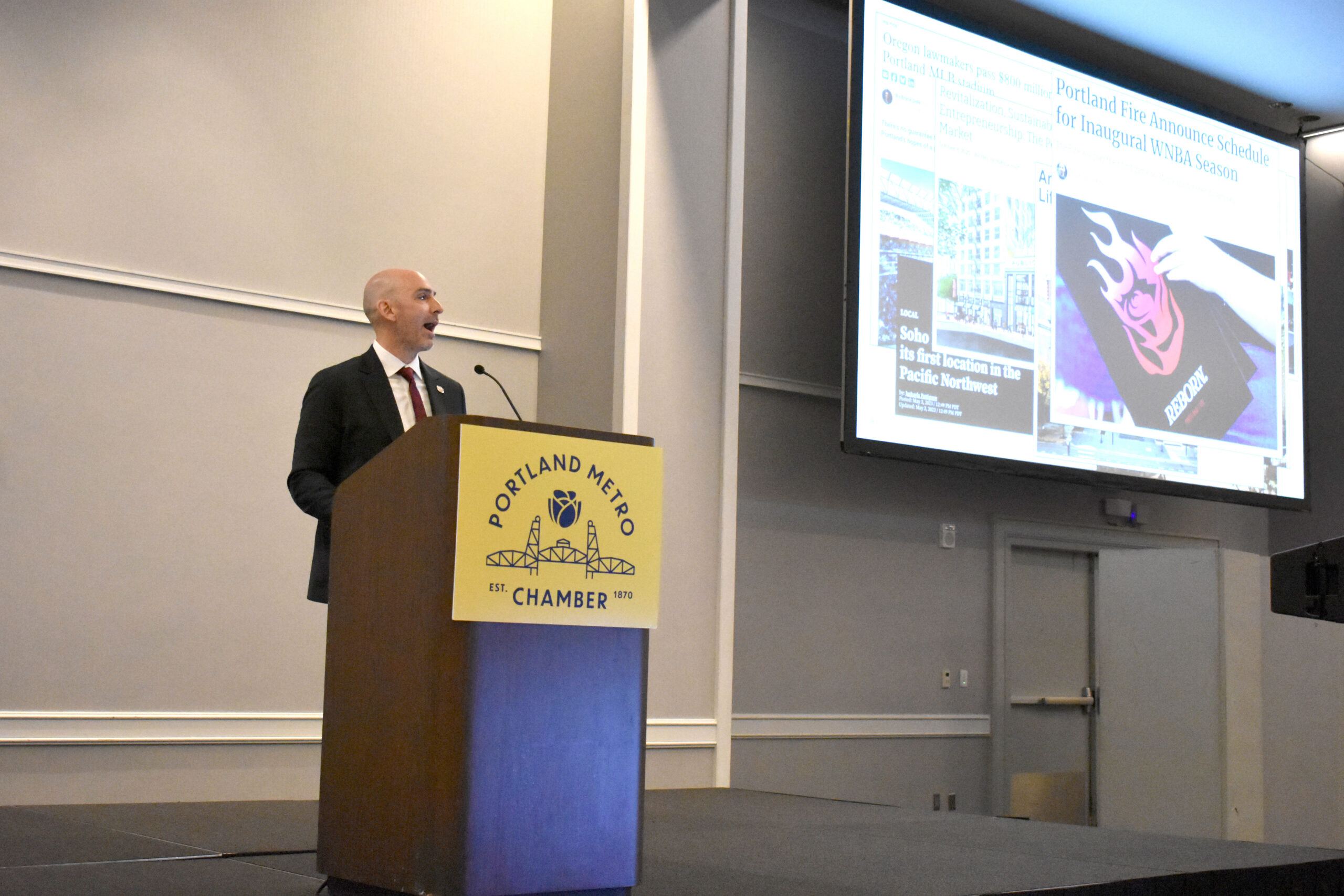
A message from Andrew Hoan at the February 12 Breakfast Forum.
A wise person once said that economics is the painful elaboration of the obvious.
As you know, we have been conducting our annual economic analysis with ECOnorthwest for 15 years. We haven’t hidden the bad news in hard times, or muted the good in the best of times. As recently as February 2020, our regional, state, and national economies were in uncharted, positive territory. However, now, everything has changed.
Much of what was presented today in our State of the Economy reports, sadly, comes as absolutely no surprise to the private sector. How we get to a better place is a more difficult question to answer– and I want to share my perspective with you.
My family is a unicorn by current standards:
- We moved here from Brooklyn, NY (in-migration);
- We had three children (natural population growth);
- And we are textbook examples of the challenges our employer community faces; with me continuing to work downtown, but my spouse’s business having relocated out of the core.
So, this is both important to my work and also deeply personal. Let’s begin with the basics and the positive. Recently, progress has been made on longstanding challenges because public-private partnerships focused on core livability issues.
Just like our economic data, our annual polling data is longitudinal, and we are noticing that residents are citing improvements in crime rates and homelessness. Portland residents are perceiving substantially more progress than those in the broader tri-county region. These trends are particularly evident in Downtown Portland where momentum continues. Visits to downtown have increased, and this past summer saw the most foot traffic downtown since pre-pandemic. There are 32 million reasons to celebrate progress, according to our year-end visitor traffic count. And that is up from 30 million in 2024.
So, how did this happen? When you restore cleanliness and safety to our core, residents and visitors alike will respond. This success in improving quality of life required shared agreements about what the priorities are, and then focused public and private sector partnerships working together to make a difference.
And there’s more, just think of the news we’ve been tracking over the past several years. From MLB to PDX, to a new world class airport, mass timber manufacturing at terminal 2, to five-star hospitality openings, multiple international performing art destinations breaking ground; to the James Beard Public Market / Portland Art Museum and more – there is a lot to celebrate. This community is ambitious and innovative, and no one can deny that as a collective we are capable of doing great things.
These uplifting stories stand in stark contrast to the economic conditions in our latest report. That is because we prioritized action on improving livability, but not job creation.
Our report’s findings are clear– our economy is on a sustained downward trajectory because of local, structural, economic policy, or lack thereof, now, more than ever before in our history. The economic foundation will not fix itself; we need focused, urgent effort around clear, shared economic priorities to see the same success in improving livability.
As it pertains to economic policy, our culture has avoided hard conversations or chosen inaction with Olympic-level acumen for decades. So, why are we here? We took growth for granted for decades. Our growth has been effectively underpinned by two companies and two industries, semi-conductors and apparel. Their unrivaled private sector expansion was taken for granted, and evergreen public revenue growth was a universal expectation.
Newsflash: those days are over.
To best understand the ‘why’, I want to drill down specifically on semi-conductors for a moment. They are the world’s single most economically valuable product ever crafted by humankind on scale; and our local innovators are the global leaders in this space. The industry took root and grew here because of our abundant, low-cost energy and water; despite our many efforts to keep it away and limit its growth.
In many ways, the meteoric growth in semiconductors masked the foundations of a broken and uncompetitive economic system. Our local economic policies didn’t earn the shoe and apparel industry, nor the semiconductor industry; in fact, many times our policies fought against them. While I know many here and in Salem are presently contemplating a life without the Blazers– but for a moment, let’s allow ourselves here today to contemplate life without Intel or Nike.
Allow me to paint that picture. The picture I am painting is Pittsburgh, in the 1970s and 80s, when the unthinkable happened, and the last steel mill closed– their region reached more than 17% unemployment and lost 180,000 residents. We have NEVER experienced that here, and we are ill-equipped to face such a localized economic calamity. And we find ourselves all too near to a ‘Pittsburgh steel-mill-closing’ moment.
Before we can chart the path forward, let’s pause to hold this moment of challenge and embrace every single anti-superlative while we are at the turning of the tide, and use it to fuel our motivation.
- We have been in a localized recession since 2023
- The region’s consumer sentiment has been last or nearly last of every metropolitan region in the country.
- We are last in multifamily housing permitting in America.
- Office vacancies are the highest in modern history for our community.
- We are one of the last in the nation to recover our downtown foot traffic for office workers.
- And while foot traffic is growing, due to Herculean effort, at this pace, it will take us an additional decade to fully recover from the pandemic.
- Our region, dependent on trade, saw the largest drop in export value in the country.
- We are 80 out of 81 on real estate investability
- We are at the bottom of 50 American cities in terms of employment.
If you are looking for the good news, at least we can only move up? We need to update the axiom, “it’s the economy, stupid”. The expression here needs a modifier: “it’s the local economic policy, stupid”.
By way of example, Multnomah County lost 2.1% of its population and 6.9% of its employment since pre-pandemic heights; while, Clark County rose 8.0% in population and grew 12.9% in employment. In the three Oregon counties that make up our regional economy, we are living in the land of good intentions and bad economic policymaking, coupled with a ballot system for taxation that has eviscerated common sense. As a result, investment is going right across the river.
The pandemic and hostile federal administration have not helped, but our current challenges are self-inflicted. We must acknowledge that we have done this to ourselves; we are no one’s victim. This matters because if you accept that truth, it provides us as a community with the agency to make changes.
Because semiconductors bailed us out when the timber industry collapsed, we never had our Pittsburgh ‘steel-mill-closing’ moment and never developed a culture of competitiveness for growth. It is time to bury our lethargic, if not outright hostile posture, towards growth; by saying goodbye to Governor Tom McCall’s adage– ‘Come visit, but don’t stay’.
We can look again to the lessons of Pittsburgh for hope– after the complete collapse of its core industries, by 2009 their community had completely reinvented itself. And they rewarded for their efforts by being chosen to host the G20 Conference by the Obama administration as a model city for having re-imagined itself, diversified its economy, and demonstrated growth. They too call themselves the ‘City of Bridges’.
To me, this moment is the opportunity Portland and Oregon need more than any other to reinvent ourselves and adopt a new path. So, how do we do that?
First, we must accept that the old Oregon Trail is dead. This state was built by people moving here for the exact purpose that people have settled and lived here since well before statehood: our amazing location on the Pacific Rim with a stunning climate. That modern history came to an abrupt end during the pandemic. Now, we must adopt a new mindset that doesn’t assume people and businesses will move here but demands that we work to retain and grow every household and business.
Second, we must build a new, sustainable foundation. It starts with actually listening to business– actually listening. There is no shortage of specific, actionable ideas from the private sector. But if you are looking for something to read, either the Portland Metro Chamber’s Regional Policy Agenda or Oregon Business & Industry’s Policy Agenda is a great place to start.
However, I am in favor of a simpler, more durable, but perhaps more difficult goal– culture change. And that starts with every policymaker adopting a clear mindset; every policy initiative must be aimed at creating new private-sector jobs or new units of housing, and if it does not do this, then it is not a priority. Prioritizing the economy does NOT relieve us of our obligation to shelter the unsheltered, serve those with substance abuse and mental health needs, or keep our communities safe. In most other places, these are simply ‘basic-local-services’.
However, the need to focus on the economy is because it pre-empts everything else in this moment, because without a prospering private sector, imagine the ability of our governments to confront the challenges we face on our streets with the scarcity they are now realizing in public budgets. We will lose fragile gains in livability if we lose our economy.
Third and finally, we must REFORM our tax system. Our entire tax policy is vastly overly dependent on large businesses and middle-income earners. As such, that system requires large businesses and middle-income earners to stay here. And presently, Multnomah County has the highest business taxes in the nation, and the second-highest marginal personal income tax rate, following only New York City. These two factors, when combined with antiquated permitting and byzantine regulations, are a local economy killer. We are on an unsustainable path.
What is reform, you might ask?
Remember this date– December 31, 2029. For decades, federal government tax policy subsidized high-income tax-dependent states by allowing unlimited ‘State and Local Tax Deductions’, aka SALT, for personal income. Our region and state developed our entire tax policy around the assumption that SALT would always exist. As a result of HB1 (or the One Big, Beautiful Bill) – on December 31, 2029– SALT will effectively cease to exist.
If at that time we are still the top income taxed county, region, and state in the nation– we will be incapable of making a legitimate financial case for why a family with a middle income wage would want to be here, or why an employer would want to retain, grow, relocate or create a middle income job in this community.
We must reform our taxes so that on January 1, 2030, we are not dead in the economic water. We cannot waste this crisis. We are in an economic emergency. My staff and I are optimistic, and we are fully embracing this as an opportunity. Everyone should.
Our new path requires us to develop our community into one that is competitive. Competitive because we are not at war with ourselves, but we are in a competition like never before with the rest of the nation and world for talent and investment. With population stagnating in this region and state, we must grow or attract households and support businesses expanding here.
To do that, we must be:
- Economically competitive against our peer cities;
- Competitive for builders to build housing AND attract investment capital;
- Competitive for employers to locate their employees in Downtown Portland; and
- Competitive to develop, retain, and attract the best and most diverse talent on earth.
To close, the business community asks this of policymakers today. Choose us– we are your businesses, your neighbors, your entrepreneurs, your employers, and your taxpayers. You should not be fighting us! We are not the enemy. We need to get onto one team– Team Greater Portland– and compete against every other region that is surpassing us economically and waiting for us to stumble.
Together, let’s turn the tide and build a community that allows every resident to thrive.